By James T. Cunningham
Gun Crazy (1950), Directed by Joseph H. Lewis, written by MacKinlay Kantor and Dalton Trumbo starring John Dall, Peggy Cummins, Berry Kroeger, Morris Carnovsky, Anabel Shaw, Harry Lewis, and Russ Tamblyn.
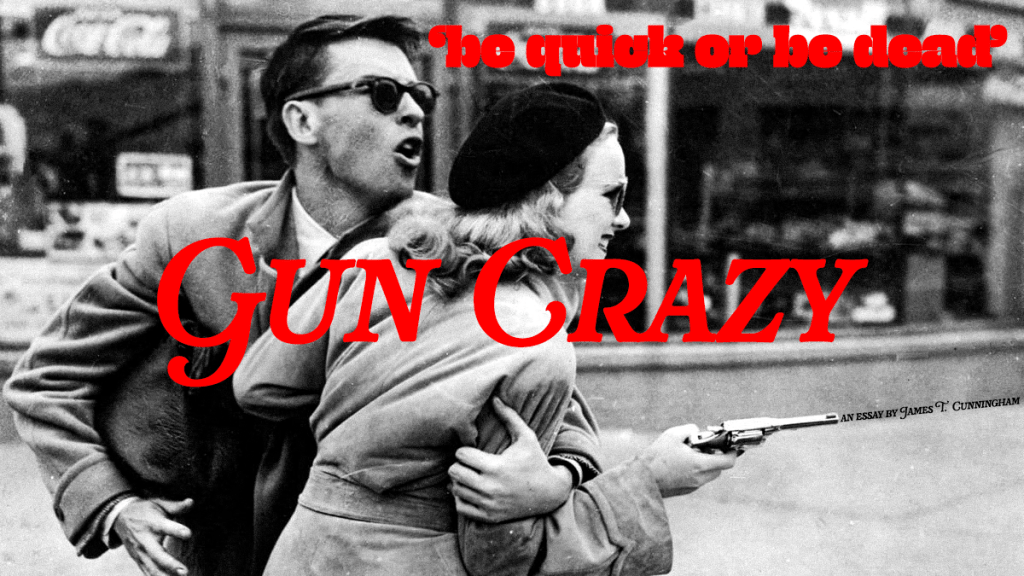
If happiness is indeed a warm gun like John Lennon wrote, then Joseph H. Lewis’ Gun Crazy is an American fairy tale. A fantasy about star-crossed lovers bound by violence and outlaw freedom told at 24 frames per second. This 86-minute roller-coaster ride barely made a splash upon its release in 1950 but went on to inspire a generation of critics and filmmakers across the globe. Yet, it remains hidden in the shadows. Patiently waiting for that unsuspecting filmgoer to press play (thank you, Tubi.) That’s due in part because Gun Crazy is the quintessential “B-movie.”
The term “B-movie” is synonymous with a certain kind of film. You know the type. Actors you don’t recognize, low budgets, and a story that usually skews from the beaten path. Sometimes people use it as a pejorative. A way to dismiss a movie that doesn’t contain the glitz and glam of a Hollywood “A” picture. Nowadays you might call it an “independent film,” but the history of the B-movie is a unique slice of American history. It was those low-budget, studio pictures from the 1930s and 40s that laid the foundation for a masterpiece like Gun Crazy to be built upon.
The 1930s were pretty wild. For starters, you have the rise of the Nazi Party in Germany, the worst recession in American history in the Great Depression, and the end of Prohibition. It’s safe to say that times were tough, and the hangover from the roaring 20s was a reality many were unequipped to deal with. One way millions of Americans escaped their daily problems (outside of booze) was going to the local movie theater. Just like that, the roads of Hollywood and Sunset Boulevard turned to gold. There was one major problem. People still didn’t have any money.
To keep butts in seats and cater to the consumer, studios would run double bills of movies. Two for the price of one. While low-budget films have always existed from lower-rung studios known as “poverty row,” by the mid- and late 1930s major studios like Warner Bros. and Paramount Pictures began shooting their own low-budget flicks they could slot behind their big-budgeted “A” films.
And thus, the B-movie as we know it was born.
Intended to be less than an hour long, these films often told violent and marginalized stories with minimal input from studio heads. Within these films is a sense of experimentation both in filmmaking technique and story. It’s where many young actors and directors got their start because studios could take a chance on unknown talent. That undiscovered talent also included many immigrants on whose backs the entire industry was essentially created.
After all, this was still America.
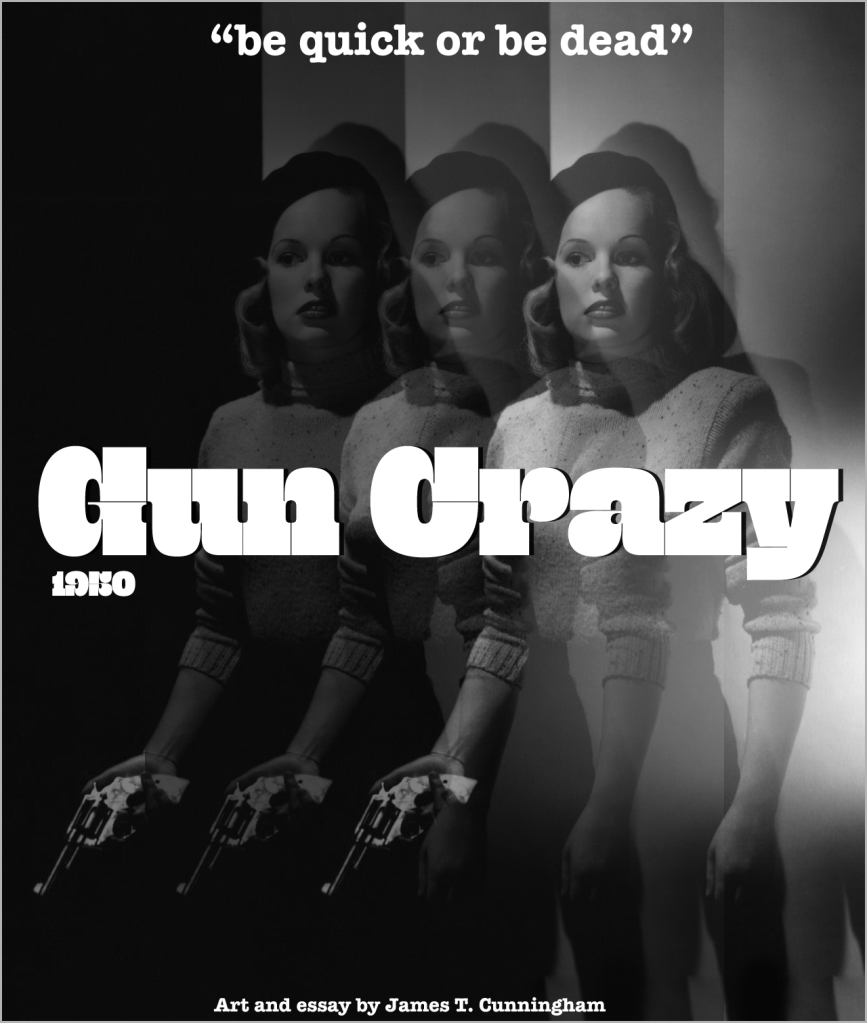
Gun Crazy arrives at the tail end of the B-movie boom and not long before the sun sets on the heyday of film noir. By 1950, there was a new enemy in the cultural zeitgeist. The Red Scare was real, which is why blacklisted screenwriter Dalton Trumbo had to pen this script under his pseudonym Millard Kaufman. Much of the ensuing decade would sanitize Hollywood films and perpetuate an American ideal that never existed. But film noir is a naturally transgressive movement. It turns over rocks just to watch bugs scatter and squirm through the tall grass. A world in which violence is always an answer and the good guy is most certainly a dead guy.
At the heart of Gun Crazy is a love story. A maddening, furious passion that leaves one bewildered that the celluloid didn’t burn out. It’s Bart (John Dall) and Annie (Peggy Cummins) against the world. The film follows a young, gun-obsessed Bart (played by Russ Tamblyn) as he returns home from a stint in reform school followed by the military. While hanging out with friends at a local carnival, he falls head over heels for Annie, a gunslinging trick-shot queen. It isn’t long before the two leave town and embark on a crime spree that would make Bonnie and Clyde blush.
Dall and Cummins are brilliant together. As the crimes kick into high gear, Bart still harbors the albatross of morality. He always remains empathetic, if not naïve. Dall is an underrated actor for his time. Appearing in landmark films like Rope and Spartacus, he was never able to rise into Hollywood stardom before passing away at 51 in 1971.
If Dall plays the “criminal with a heart of gold,” it’s Peggy Cummins who plays the “devil in disguise.” She is perhaps the most violent and sadistic femme fatale of any film noir, and if you know the genre, that is saying something. Her performance is sublime. Every smile, every look at the camera sends a cold shiver down your spine. No step is too far, and anything can be solved with a loaded gun. She uses her delicate appearance and petite frame as a façade. Behind it is a heartless entity. A killing machine. A woman with a gun.
Unsurprisingly, their ending is a tragic one. Fit for a Shakespearean drama and retrofitted for a Hollywood soundstage. But it’s their love for one another that never dies. It glues the film together and elevates the source material.
By the time Joseph H. Lewis shoots Gun Crazy (pun intended), he has directed over 20 B-movies, and the expertise is evident. Using tons of on-location shots, Lewis puts the viewer in the backseat of the lead’s getaway car. Literally. The entire film is a technical feat, but the nearly four-minute single shot of a bank heist from beginning to end is remarkable. We watch from the back seat as the car pulls around a dusty town to the bank. Bart runs in to perform the heist, and we stay outside with Annie. When an unsuspecting police officer stops in front of the bank, Annie jumps out of the car to use that feminine façade and distract him. The camera stays put, leaning in and panning to the sidewalk as Annie stalls the police officer until Bart leaves with the money. Pure cinema.
Martin Scorsese is on record speaking very highly of this film and its influence can be found throughout his work. Taxi Driver screenwriter and Hollywood iconoclast Paul Schrader called Gun Crazy “one of the best American films ever made.” I think labeling it an American film is an important distinction. Remember, this picture came at a time when films were one of our biggest cultural exports and the power they wielded was unparalleled. You can’t see John Dall in those black sunglasses and not think of French New Wave films like Breathless or any number of Quentin Tarantino’s characters. Because at the end of the day, technical film jargon aside, this movie is just so damn cool.
Gun Crazy is not a film about America. It is America.
 NeverDead Productions
Leave a comment