By James T. Cunningham
Point Blank (1967), Directed by John Boorman, written by Alexander Jacobs, David Newhouse, and Rafe Newhouse starring Lee Marvin, Angie Dickinson, Keenan Wynn, Carroll O’Conner, Lloyd Bochner, John Vernon, and Sharon Acker.
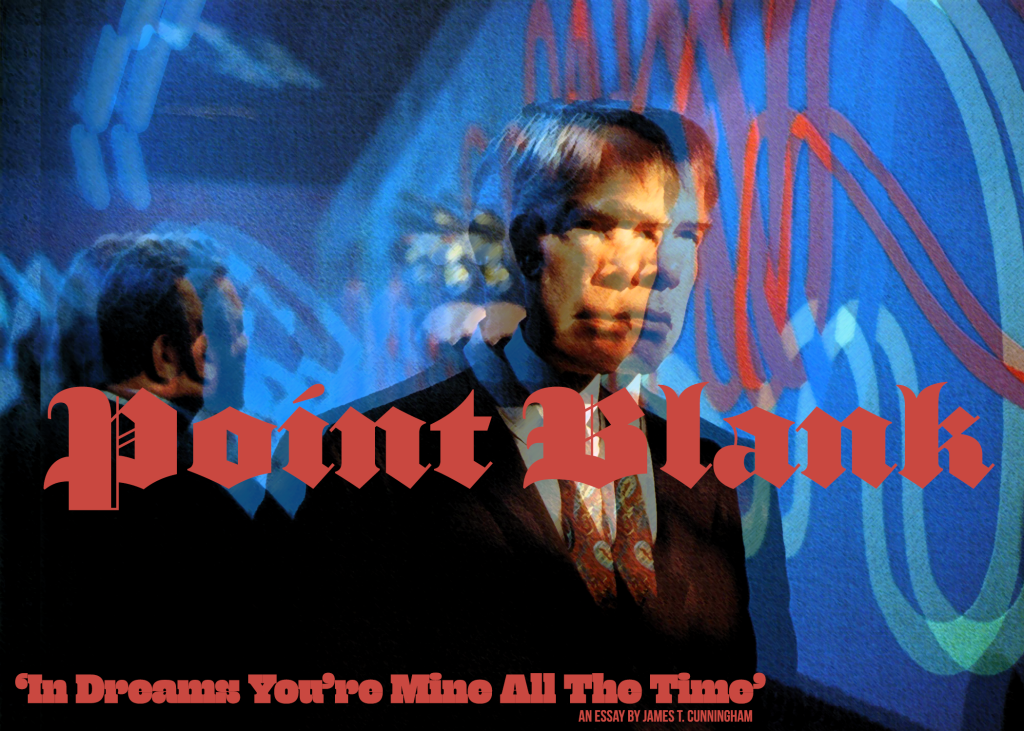
“Cell. Prison cell. How did I get here?”
These are the first words spoken in John Boorman’s neo-noir masterpiece, Point Blank. It is where the film begins. Or is it where it ends? Because what ensues over the next ninety minutes will leave you questioning the very fabric in which the story is woven through. The seamless flashbacks that bleed back and forth between past and present. It is a kaleidoscopic descent through the changing landscape of Los Angeles on the brink of a full-blown countercultural revolution. One thing is for certain, this is where we meet Walker.
After a big score in the empty bowels of Alcatraz, Walker (Lee Marvin) is double-crossed by his partner Reese (John Vernon) and left for dead in a cold, empty cell. Did he die? Is the subsequent film all a death dream? Boorman isn’t interested in spoon-feeding us the answer. He is too concerned with shadowing Walker as he exacts his revenge up and down the coast of California in search of the $93,000 that was stolen from him. A figure that would amount to slightly under a million dollars with inflation today.
Point Blank is the result of a Hollywood studio hedging against the artistic curve of what’s to come. Not far in their rearview mirror were the stars and starlets of yesteryear. Clouded in cigarette smoke and the churned-up dust of the Hollywood machine trudging ahead, a new movement was emerging. The war in Vietnam was underway and young men across America were opening mailboxes with shaky hands to find draft cards. Martin Luther King Jr. was leading the charge for the civil rights movement. Dylan had gone electric and Jimi Hendrix made his American debut at the Monterey Pop Festival.
It was 1967. The vibes were harsh. Our youth were stoned. Change was in the air.
This was the state of the country that John Boorman found himself in when the flagship Hollywood studio MGM (now owned by Amazon) hired him to direct the picture. At the time he was a little-known director out of England who had made only one film, Catch Us If You Can. A movie centered around British pop group the Dave Clark Five that was directly inspired by the success of A Hard Day’s Night one year earlier. Although it didn’t achieve significant box office success, the strong reviews it received played a crucial role in establishing his reputation.
The story goes that after a sit-down with the green director, it was Lee Marvin who became convinced that Boorman was right for the project. Once on board, Marvin told MGM studio heads that any and all power he had would instead go to Boorman, effectively granting him full creative control over his first Hollywood film. It’s curious to think what exactly Marvin saw in this young, largely unproven director that pushed him to grant Boorman creative control. Then again, Lee Marvin seemed like the kind of guy who listened to his gut. And his gut said Boorman.
The result of bringing an outsider perspective to a uniquely American subgenre lent itself to the bizarre, stylized world of Point Blank. Although the unique sensibility of the film cannot be debated, it did derive from an original piece of source material. The movie is an adaptation of a Richard Stark (the penname for Donald E. Westlake) novel, The Hunter. Similar to Point Blank, the novel follows a revenge-obsessed criminal who goes by a single name, Parker, as he tracks down the men who wronged him. Other elements of the book appear in the film, but it is not a straight adaptation. Perhaps the most significant change was to move the plot from New York City to San Francisco and Los Angeles.
In a recent interview for its Criterion release, famed independent director Jim Jarmusch claimed that Point Blank was “the greatest L.A. crime film of all time.” A bold take from Jarmusch, but there is absolutely a spot saved in the pantheon of Los Angeles crime films where you can safely slot Boorman’s classic. It is quintessential California. From the way Lee Marvin’s shiny white hair gleams in the Santa Monica sun right down to the pitiless water running through the L.A. River and the kingdom of concrete that encapsulates it. The film just looks different. This is also in part due to Boorman bringing some swinging 60s London fashion across the pond with him. The whole movie is a ’60s time capsule, but the women seem to have plucked their outfits right out of the boutique shops lining the Chelsea streets. When juxtaposed against Marvin’s old-school Hollywood mystique, you get something entirely unique on screen. Something different.
The movie would never work without the full buy-in from Lee Marvin. It was only five years earlier that he had starred alongside Jimmy Stewart and John Wayne in the undisputed American classic, The Man Who Shot Liberty Valance. No doubt a Hollywood player, Marvin was never a movie star to succumb to the times. A man born against the grain, he had been a decorated war veteran who fought in World War II and the Battle of Saipan. Unlike Elvis Presley, Marvin saw severe combat that he would carry with him for the rest of his life. He seemingly didn’t have a disingenuous bone in his body, and if he did, he never once showed it. It was this outsider perspective that refined the edge he seemed only too comfortable to balance upon. It’s what made him perfect for the role of Walker.
A character all but void of words and emotions, Walker behaves more like a ghost moving through time than a man on a mission. The easiest scene to point to is one of the earliest in which he sits down with his estranged wife, Lynne (Sharon Acker), on the couch. It the first stop on his long, vengeful road, and he doesn’t speak a word. He sits, slouched on the couch, staring at the coffee table in front of him while Lynne spills her guts. She asks and answers her own questions as if Walker were nothing more than a specter sent to visit her. The ghost of Christmas past.
As Walker works his way up the food chain of organized crime, a new door is continually opened. There is always someone else higher up responsible for his situation. Known only as “The Organization,” Reese, Carter, Brewster, and Fairfax are all cogs in a machine that we never fully grasp. A snake eating its own tail, it’s as if Walker could spend the rest of eternity chasing down and killing the men who wronged him without ever killing enough of them.
Point Blank was a film made during a time of great transition. But it was also a time for hope. Change. The thought that a difference could be made in our unfair world if we banded together and resisted. Black and white. Man, woman. In the same stroke, it was a film that predicted the hopelessness that permeated the oncoming decade. When we awoke from the dream of peace to find that it never really mattered.
Did Walker ever leave that cell on Alcatraz? Was this whole tale spun together in the mind of a dying man?
Who cares? It’s about the ride. And revenge will always be a dish best served cold, just like the bullet with your name on it.


Leave a Reply