By: James T. Cunningham
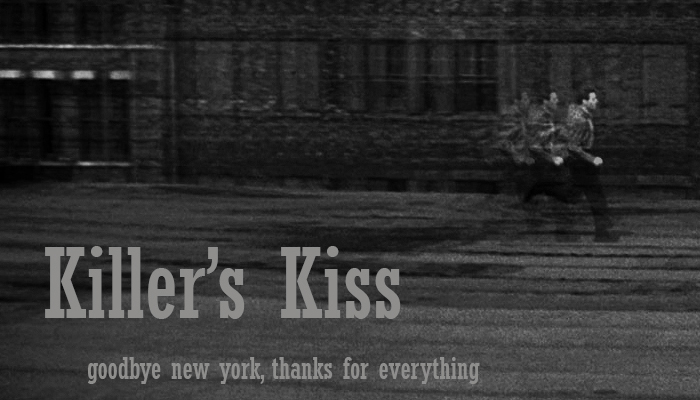
Killer’s Kiss (1955), Directed by Stanley Kubrick, written by Stanley Kubrick and Howard Sackler, starring Jamie Smith, Irene Kane, Frank Silvera, Jerry Jarrett, and Felice Orlandi.
Viewing an artist’s early work is a special experience. There remains an unpolished edge to it. A hunger. This ‘shot out of a cannon’ sensibility can be difficult to resurrect in later work, especially when fame and money are achieved. Filmmaking is unique in the sense that the art you create is directly related to the budget you are given. Which forces first-time or unproven directors to rely on raw creativity and instinct to achieve their vision. Much of the time this pressure creates coal, but every so often a brilliant, glinting diamond is formed. A generational talent emerges fully formed and puts the whole industry on notice. Every once in a while, we get Stanley Kubrick and Killer’s Kiss.
At the tender age of just twenty-six, Killer’s Kiss would be a return to form for the young filmmaker. After the creation of his debut feature, Fear and Desire, in the San Gabriel Mountains, a film he would come to completely disown, Kubrick wanted to play a game on his home court. He set his crosshairs on an ultra-low budget noir picture he could film in New York City. It would become his love letter to a city and subgenre that brought him such joy and inspiration. A place he was born and raised. Coincidentally, it would also mark the last Kubrick film based solely on an original screenplay.
For this, Kubrick tasked his old high school buddy and future Tony Award and Pulitzer Prize-winning writer, Howard Sackler, to cook something up. Something they could shoot on the cheap. Of course, Kubrick made his own contributions to the script, which would earn him a story credit as well as directing, editing, and photographed-by credits. It would be a film that explored the dark, dingy alleys you avoided on your way home. A cold shiver from a warm kiss. Sex, violence, and boxing.
It would be called Kiss Me, Kill Me.
Arguably a better title, but the alliteration of Killer’s Kiss cannot be ignored. In the hands of nearly every other working filmmaker, this movie would be another studio B-picture. Cast out to the cinemas behind something bigger and glitzier audiences paid to see. At best, it landed at RKO and held some of the same edge that Kubrick delivers.
The movie follows struggling boxer Davey (Jamie Smith), recounting the last several days as he waits to catch a train out of the city. The story is told in flashbacks and heavy voice over. Davey had fallen in love with Gloria (Irene Kane), a call girl with striking beauty in the building next door and whisked her away from her psychotic pimp Vinnie (Frank Silvera).
Simplicity would be an ally to the script. The setting is known, the cast is small, and tension is like the skin of a snare drum. Working within the confines of a genre allows filmmakers the opportunity to break an arranged agreement made with the audience. We expect one thing but are presented another. It zigs when we think it will zag. In the case of film noir, there are a plethora of preconceived notions that we enter the picture with. The beat-down detective in over his head, the femme fatale plotting behind the scenes, and cigarette smoking that takes on a character all to itself. It’s not that Kubrick subverts any number of these cliches but rather presents them through the lens in which he sees them.
You must remember, by 1955 the noir movement had all but fizzled out. The final nail in the coffin would come this same year in the absolutely searing Kiss Me Deadly by Robert Aldrich. The film was a lightening rod through the heart of Eisenhower’s America. In response to the morbid outcry from both religious and political institutions across the board, Aldrich penned a fantastic article in the New York Herald Tribune defending the violence in his film and cinematic violence in general, titled “You Can’t Hang up the Meat Hook.”
Despite the stuffy air surrounding 1955, this was also a time, especially in New York City, when an artistic fervor began to take shape. It was the year Allen Ginsberg penned his landmark poem Howl and published it in ’56. Jack Kerouac would solidify this artistic and rebellious movement in 1957 with the fearless American classic On the Road. Often cited as one of the most important pieces of American fiction from the 20th century. At the same time, in the same city, abstract expressionism filled the galleries downtown. Jackson Pollock and Willem de Kooning became crowned princes of the New York art scene. Chaos flourished. Kubrick got his camera ready.
These bold, artistic tendrils rippled through the city and reverberated through the young filmmaker. While he could never be mistaken as a ‘beat kid,’ this was the cultural and creative climate brewing in the same city Kubrick would shoot his sophomore feature. A movement that favored energy over traditional artistry.
On its surface, Killer’s Kiss might not carry the thematic weight that Kubrick’s later films undoubtedly did, but that’s not the point. This is independent filmmaking at its core. A young artist at work. Where far away are the glinting lights of studio sound stages and their buttoned-up executives fawning over every inch of production. It would be New York, in all her beastly glory, that would serve as his canvas and a 35mm handheld camera that would act as his brush. The celluloid never stood a chance. And neither did the audio.
Adding to the otherworldly quality of the film, Kubrick decided to shoot entirely without sound and instead add it all in post-production. A strategy utilized in his first film, Fear and Desire, would once again prove to be a costly and tedious move. In the case of Killer’s Kiss, it allowed him more freedom to get shots he otherwise would not have been able to. All the sidewalk close-ups in Times Square that showed Davey pacing anxiously or the shocking boxing sequence that put the audience in the ring alongside the fighters. These would be nearly impossible to get without a boom mic operator getting in the way. This is also where the handheld camera would come into play.
There wasn’t much use of handheld cameras during this time, but Kubrick was particularly inspired by another terrific B-noir from 1952, The Narrow Margin. Another low-budget knockout from RKO Radio Pictures, The Narrow Margin takes place almost entirely on a train and heavily utilizes a handheld camera to better convey its tight quarters. In particular, a thrilling fight scene in a train cabin where an actor literally kicks the camera lens. These shots were made possible solely because of the handheld camera.
This is not to say that the cast and crew had an easy shoot. It went over budget and principal photography was extended by months. Also, Kubrick was forced to change the ending to a happy one. Something he deeply regretted, but when United Artists offered him $100 thousand for the film and $100 thousand for his next film, the young Kubrick quickly jumped into the editing room. It was an artistic compromise in the moment, but those wouldn’t last long.
Shooting on location in New York was the smartest decision Kubrick made when creating Killer’s Kiss. It’s as though he scouted the locations by searching the far reaches of his memory and overtime that memory had withered and faded. The crumbling rooftops, streets, and buildings all feel pulled from the subconscious of someone in a deep sleep. Dreaming about a city ready to devour the world, where dark are the corners in which danger always lurks.
It culminates in a final showdown between good (Davey) vs. evil (Vinnie) in an abandoned mannequin factory. Black, lifeless eyes watch on as Davey dodges swings from Vinnie’s fire axe. Consumed with jealousy and rage, Vinnie looks more like a rabid dog foaming at the mouth than a human being. There is a slight Lynch quality to this sequence, an absurdity that casts the movie we’ve already seen in a different light. Perhaps it was not conjured in a dream but a nightmare.
The ending is memorable, but the most widely discussed scene in the film is Davey’s fight in the beginning. The first film Kubrick ever shot was a short-documentary film titled Day of the Fight (1950). He understood that if he could insert a boxing sequence into Killer’s Kiss, he could flex some muscle and reuse techniques that worked well in Day of the Fight. Also, Kubrick was a massive fan of the sport and wanted another excuse to have a boxing scene in a film.
The artist has their own personal relationship to their early work. There can often be a sense of embarrassment when they look back at it. In the case of Kubrick, he didn’t disown Killer’s Kiss, but he did not like it. It’s understandable knowing the kind of perfectionist he was and would further become. Killer’s Kiss is brilliant because it is not perfect. Because it isn’t afraid to be vulnerable or, rather, fearless. It’s pure vision. Pure creativity. The celluloid is nearly bursting at the seams with it. Everything was right in front of him. He could see it even if we couldn’t.
Kubrick would later return to live in New York in the mid-60s before relocating to England for the remainder of his life. But it would always remain a home. After all, it was the place he saw his first films and learned how to play chess. It was his window to the world. Where imagination could roam free twenty-four hours a day, seven days a week. And it’s this vision, his vision, of the city that will live forever in Killer’s Kiss.
 NeverDead Productions
Leave a comment